Clusy .
Build, branch, and evaluate ML workflows with AI-powered notebooks. Cloud-native platform for data science teams to automate experiments and optimize models.
More About Clusy
Clusy
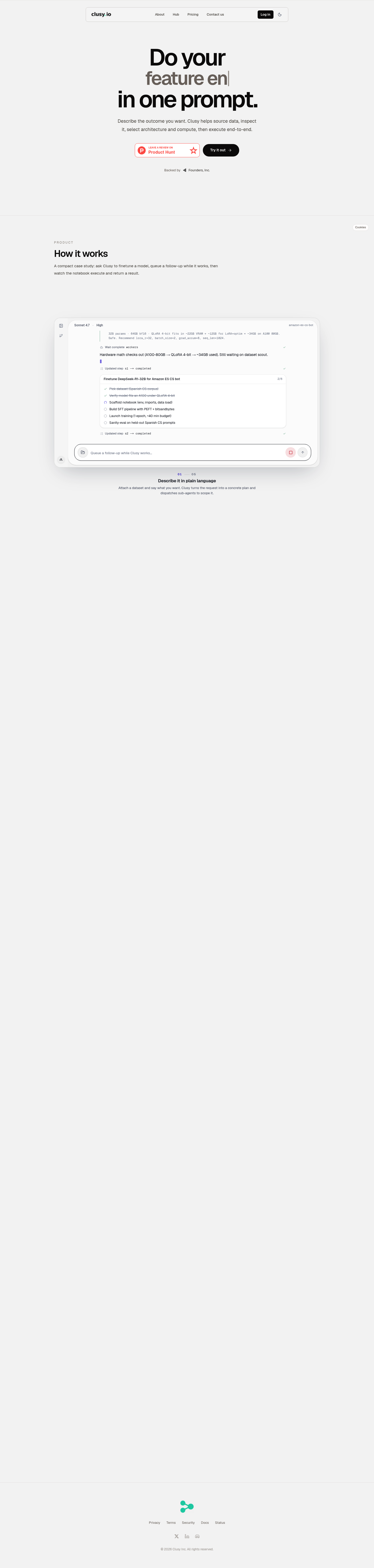
Clusy is an agent-native notebook platform that transforms how machine learning engineers and data scientists approach model development. By enabling users to describe their desired outcomes in plain language, Clusy autonomously handles the entire ML workflow—from data sourcing and inspection to architecture selection, compute provisioning, and end-to-end execution. This eliminates the repetitive boilerplate and infrastructure management that typically slows down AI experimentation.
Product Highlights
- Agent-Native Architecture: Built from the ground up with autonomous agents that handle sub-tasks independently, allowing users to queue multiple follow-up requests while work continues in the background.
- Natural Language Interface: Simply describe what you want to build—such as fine-tuning a LoRA model—and Clusy translates your intent into a concrete execution plan without manual coding.
- End-to-End Automation: Automatically sources datasets, inspects data quality, selects appropriate model architectures, provisions compute resources, and executes the complete training pipeline.
- Interactive Notebook Execution: Watch your ML workflows run in real-time within a familiar notebook interface that combines the flexibility of Jupyter with autonomous agent capabilities.
Use Cases
- Rapid Model Prototyping: Data scientists can quickly iterate on fine-tuning experiments by describing target behaviors and letting Clusy handle data preparation, hyperparameter selection, and training orchestration.
- Automated Data Pipelines: ML engineers can offload tedious data sourcing and validation tasks to Clusy's sub-agents, freeing time for higher-level architecture decisions.
- Scalable Experimentation: Research teams can queue multiple model variants and parameter sweeps simultaneously, dramatically accelerating the path from idea to trained model.
Target Audience
Clusy is designed for ML engineers, data scientists, and AI researchers who want to move faster from concept to trained model without sacrificing control over their experiments. It particularly appeals to practitioners tired of repetitive infrastructure setup and those seeking to leverage autonomous agents for more productive, hands-off model development workflows.
You might also like
See all alternatives →