Polygram Coding Agent.
AI-native coding assistant with multi-agent workflows and smart model routing. Boost productivity in VS Code, Cursor & Antigravity with intelligent code generation.
More About Polygram Coding Agent
Polygram Coding Agent
Polygram Coding Agent is the smartest AI-powered development assistant built specifically for frontend developers who want to ship code faster without burning through premium AI tokens. By combining intelligent model routing, persistent project memory, and seamless IDE integration, it transforms fragmented coding workflows into a unified, team-ready environment where context never gets lost.
Product Highlights
-
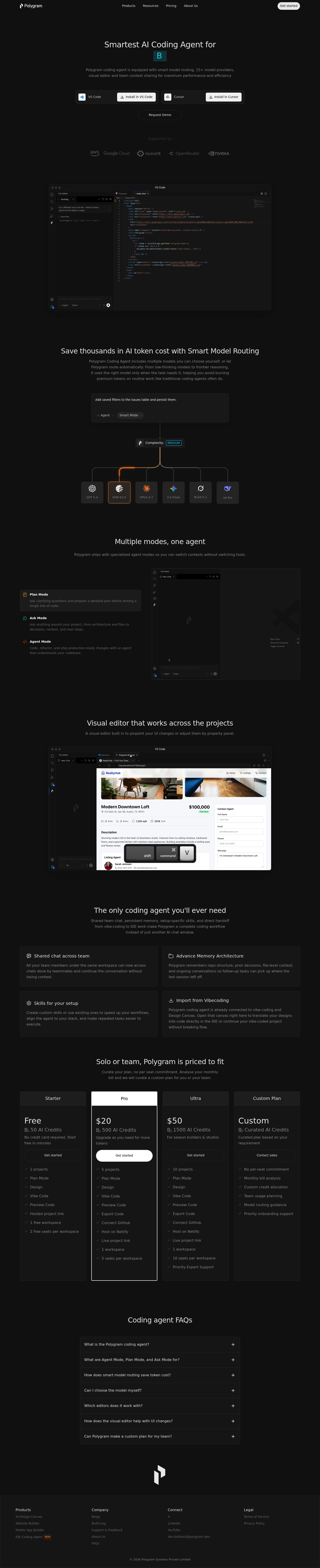
Smart Model Routing: Automatically matches tasks to the optimal AI model tier—using cost-efficient models for routine edits and frontier reasoning models only when complexity demands—saving thousands in token costs compared to agents that default to expensive models for every request.
-
Persistent Context Memory: Remembers repo structure, prior decisions, file-level context, and ongoing conversations across sessions, enabling follow-up tasks to resume exactly where the last session ended without repetitive explanations.
-
Multi-Mode Agent Intelligence: Switch between Agent Mode (executes code changes), Plan Mode (prepares detailed implementation strategies with clarifying questions), and Ask Mode (answers project questions without file modifications) depending on whether you need execution, strategy, or context.
-
Visual Editor Integration: Built-in visual editing tools let you pinpoint UI changes directly on the interface and adjust properties through panels, eliminating the friction of describing every pixel in text chat.
-
Team Context Sharing: Shared team chat and workspace persistence allow all members to access teammate conversations, continue work without losing context, and maintain collective project knowledge across distributed teams.
-
Flexible Model Access: Connect to 15+ model providers including GPT 5.4, KIMI K2.6, OPUS 4.7, 3.5 Flash, Build 0.1, and V4 Pro with manual selection or automatic routing based on task complexity.
-
IDE-Native Workflow: Deep integration with VS Code and Cursor keeps the agent inside your existing development environment rather than forcing context switching to separate tools.
-
Custom Skills System: Create setup-specific skills or use existing templates to align the agent to your tech stack, accelerate repeated tasks, and standardize workflows across projects.
Use Cases
-
Frontend Feature Development: Rapidly build, refactor, and ship UI components with intelligent assistance that understands your component library, styling patterns, and project architecture without starting from scratch each session.
-
Cross-File Refactoring: Execute complex refactoring operations across multiple files with an agent that maintains awareness of dependencies, imports, and structural relationships throughout the codebase.
-
Team Knowledge Preservation: Capture and share implementation decisions, debugging sessions, and architectural discussions in persistent team chat that new members can reference and continue without losing institutional knowledge.
-
Cost-Controlled AI Scaling: Reduce AI infrastructure spending by automatically routing simple tasks to lower-cost models while reserving premium reasoning capabilities for architecture decisions, complex debugging, and edge cases.
-
Design-to-Code Translation: Open integrated Design Canvas and vibe-coding environments directly within your IDE to convert visual designs into production code without breaking creative flow or switching applications.
-
Legacy Codebase Maintenance: Navigate and modify unfamiliar or aging code with an agent that builds persistent understanding of patterns, conventions, and historical decisions across extended engagement periods.
Target Audience
Polygram Coding Agent serves individual frontend developers seeking to accelerate delivery without AI cost surprises, as well as engineering teams and studios requiring shared context, collaborative workflows, and flexible per-credit pricing without mandatory per-seat commitments. It particularly benefits organizations already spending heavily on AI coding tools who want usage-optimized plans tailored to actual consumption patterns.
You might also like
See all alternatives →