Zro.
Zero-retention open-model inference on global infrastructure. Secure, fast, and optimized for coding agents with complete privacy.
More About Zro
Zro
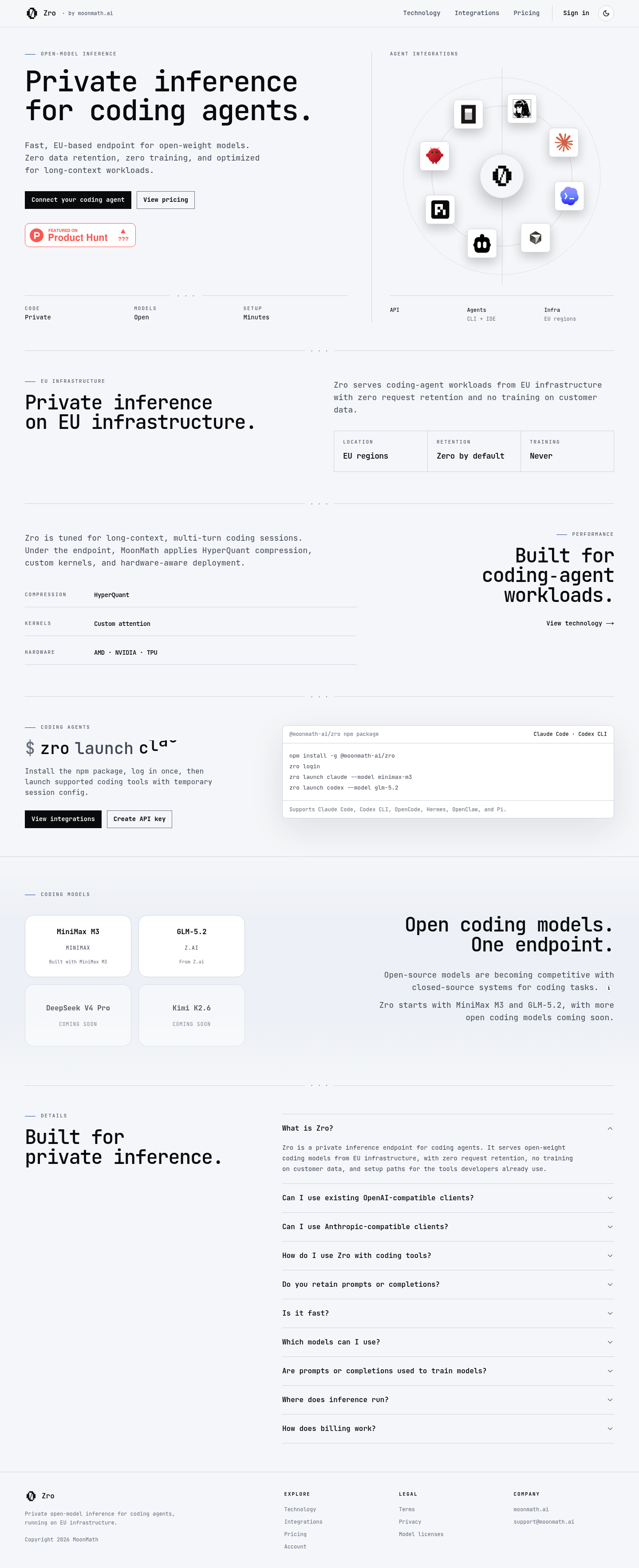
Zro is a private inference endpoint designed specifically for coding agents, delivering fast, secure access to open-weight AI models from EU-based infrastructure. With zero data retention, no training on customer data, and seamless integration with popular developer tools, Zro enables teams to harness powerful coding models without compromising privacy or performance.
Product Highlights
- Private by Design: Zero request retention and no training on customer data ensures your code and prompts remain completely confidential
- EU Infrastructure: Runs on privacy-forward servers in Finland and France, meeting strict European data protection standards
- Open-Weight Models: Access competitive open-source coding models including MiniMax M3 and GLM-5.2 through a single endpoint
- Tool Integration: One-command setup for Claude Code, Codex CLI, OpenCode, Hermes, OpenClaw, and Pi via the
@moonmath-ai/zronpm package - Optimized Performance: HyperQuant compression, custom attention kernels, and hardware-aware deployment on AMD, NVIDIA, and TPU for responsive, streaming inference
- API Compatibility: OpenAI-compatible chat completions and Anthropic-compatible Messages endpoints for easy migration
Use Cases
- Secure Enterprise Coding: Development teams in regulated industries can leverage AI coding assistants while maintaining strict data sovereignty and compliance
- Privacy-Conscious Development: Individual developers and startups who want AI-powered coding tools without exposing proprietary code to third-party training pipelines
- Multi-Tool Workflows: Engineers using multiple coding agents can standardize on one private inference backend across Claude Code, Cursor, Cline, and other supported tools
- Long-Context Sessions: Complex refactoring, code review, and multi-file editing tasks that require extended conversation history with AI assistants
Target Audience
Zro is built for software developers, engineering teams, and organizations that prioritize data privacy while seeking the productivity benefits of AI coding assistants. It particularly serves users in Europe and regulated industries who need GDPR-aligned infrastructure without sacrificing model performance or integration convenience.
You might also like
See all alternatives →